Disrupting AI Spending: Brian Kolbusz Targets the Pilot-to-Scale Gap
PR Newswire
TAMPA BAY, Fla., Nov. 5, 2026
On Disruption Interruption, Brian Kolbusz, Founder of BKAI, explains why successful AI pilots can fail to deliver business results at scale, and how decision architecture can give companies a clearer path from experimentation to measurable value.
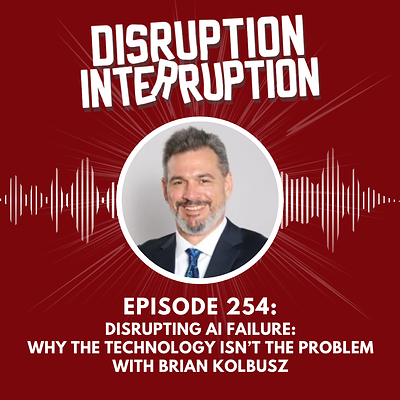
TAMPA BAY, Fla., Nov. 5, 2026 /PRNewswire/ -- Forty-four percent of CEOs struggle to demonstrate financial returns from artificial intelligence (AI) to stakeholders, according to Gartner. The finding comes as businesses continue investing in the technology, leaving leaders under greater pressure to explain what each AI initiative is expected to accomplish and how its results will be measured. Brian Kolbusz, Founder of BKAI, a strategy consultancy that helps companies plan and govern AI, joins host Karla Jo Helms (KJ) on the Disruption Interruption Podcast to discuss what happens when companies start with the technology rather than the business decisions behind it. Kolbusz describes what he calls decision architecture as a way to connect AI use cases, implementation, and performance measures directly to the company's business objectives. "Decision architecture takes you back to your roots," Kolbusz says.
AI Spending Can Outrun the Business Case
Kolbusz says AI decisions often begin inside individual departments after leaders encounter a new tool, hear what competitors are doing, or feel pressure to move quickly. Without companywide coordination, teams can duplicate technology spending and pursue overlapping AI initiatives. Kolbusz says the financial impact can build over time. "I've seen that go into multi-year six figures," he says.
A successful pilot can create another problem if leaders assume the same results will hold across the organization. Gartner reported in September that only 22% of organizations had successfully scaled AI across multiple business units or adopted an AI-first approach. At scale, companies may discover that their infrastructure cannot support increased demand, existing workflows are incompatible with the technology, or employees are unprepared to use it effectively. Those setbacks can also weaken confidence in future initiatives, especially when early results created unrealistic expectations. "A pilot is a best-case scenario. It is set up to succeed," Kolbusz says.
Decision Architecture Starts Before Deployment
Kolbusz recommends setting business objectives before deciding where AI should be deployed, objectives annually with a focus on 12-month goals. He uses a 60/40 framework: 60% of the strategy should focus on customers, including experience and growth, while 40% should address the internal processes required to support those goals.
The people doing the work should be part of that plan. Frontline employees know which tasks consume time, where processes break down, and which parts of their work are repetitive. Instead of deciding every use case from the executive level, he recommends asking employees a practical question: "What do you do that you have to do that you hate doing?" Kolbusz says. "That's your initiative."
Success also depends on choosing the right measure for the project. Kolbusz describes a behavioral health clinic that used recordings of its retiring receptionist's voice in an AI phone system to preserve a familiar patient experience. The clinic tracked patient satisfaction as the key outcome, and Kolbusz says it remained high. He adds that smaller companies should not assume AI is only suitable for larger organizations. "Don't pigeonhole yourself into a size," he says. "AI is the greatest tool you have to disrupt an industry."
Links
Disrupting AI Failure: Why the Technology Isn't the Problem with Brian Kolbusz
Disruption Interruption is the podcast where you will hear from today's biggest Industry Disruptors. Learn what motivated them to bring about innovation and how they overcame opposition to adoption.
LinkedIn: https://www.linkedin.com/in/bkolbusz/
Company Website: https://bkai.io
About Disruption Interruption™
Disruption is happening on an unprecedented scale, impacting all manner of industries — MedTech, Finance, IT, eCommerce, shipping, logistics, and more — and COVID has moved their timelines up a full decade or more. But WHO are these disruptors and when did they say, "THAT'S IT! I'VE HAD IT!"? Time to Disrupt and Interrupt with host Karla Jo "KJ" Helms, veteran communications disruptor. KJ interviews bad asses who are disrupting their industries and altering economic networks that have become antiquated with an establishment resistant to progress. She delves into uncovering secrets from industry rebels and quiet revolutionaries that uncover common traits — and not-so-common — that are changing our economic markets… and lives. Visit the world's key pioneers that persist to success, despite arrows in their backs at www.disruption-interruption.com.
About Brian Kolbusz
Brian Kolbusz is the Founder and Chief Decision Architect of BKAI, where he works with leadership teams on AI readiness, governance, use-case selection and technology decisions before deployment. He has more than 25 years of experience across enterprise technology, operations and modernization, including leadership roles in highly regulated and mission-critical environments.
About Karla Jo Helms
Karla Jo Helms is the Chief Evangelist and Anti-PR® Strategist for JOTO PR Disruptors™. Karla Jo learned firsthand how unforgiving business can be when millions of dollars are on the line — and how the control of public opinion often determines whether one company is happily chosen, or another is brutally rejected. Being an alumnus of crisis management, Karla Jo has worked with litigation attorneys, private investigators, and the media to help restore companies of goodwill into the good graces of public opinion — Karla Jo operates on the ethic of getting it right the first time, not relying on second chances and doing what it takes to excel. Helms speaks globally on public relations, how the PR industry itself has lost its way, and how, in the right hands, corporations can harness the power of Anti-PR to drive markets and impact market perception.
References
- Gartner. (2026, October 20). Gartner says 44% of CEOs struggle to demonstrate AI financial returns as technology becomes central to growth. gartner.com/en/newsroom/press-releases/2026-10-20-gartner-says-44-percent-of-ceos-struggle-to-demonstrate-ai-financial-returns-as-technology-becomes-central-to-growth
- Gartner. (2026, September 1). Gartner survey finds only 22% of organizations have successfully scaled AI across multiple business units. gartner.com/en/newsroom/press-releases/gartner-survey-finds-only-22-percent-of-organizations-have-successfully-scaled-ai-across-multiple-business-units
Media Inquiries:
Karla Jo Helms
JOTO PR™
727-777-4629
 View original content to download multimedia:https://www.prnewswire.com/news-releases/disrupting-ai-spending-brian-kolbusz-targets-the-pilot-to-scale-gap-302930977.html
SOURCE Disruption Interruption


